Finishes
Metal finishes and what they do to light.
The 6 finishes in Jart's studio, from mirror polish to oxidised patina. Each one changes how the metal reflects light: how sharp the highlights are, how far they spread and which way they run.
The finishes at a glance
Roughness is how much a surface scatters reflections, from 0 (a perfect mirror) to 1 (fully matte). It is the value Jart sets when you choose the finish; you can still change it afterwards.
| Finish | Roughness | Surface | Often used for |
|---|---|---|---|
| Polished | 0.15 | No texture: a smooth, mirror-bright surface. | Bridal, high jewellery, anything set with stones. |
| Brushed | 0.38 | Fine parallel grooves that follow the part: around a band, along a bar. | Men's bands, contrast panels next to a polished edge. |
| Satin | 0.52 | A very fine crossed texture, finer than brushing. | Wedding bands, modern minimal pieces, inside a shank. |
| Hammered | 0.30 | Broad, irregular dimples, as left by a planishing hammer. | Artisan bands, organic and handmade looks. |
| Sandblasted | 0.55 | A dense random grain, like a bead-blasted or frosted surface. | Frosted borders, contrast behind pavé, a soft-touch look. |
| Patina | 0.42 | Mottled oxidised patches over the bare metal. | Oxidised silver, vintage and antique styles. |
Each finish, rendered
The band of the studio's sample solitaire with each finish at its default relief, rendered in Jart's Render mode under the Softbox lighting: 18k yellow gold, and sterling silver for patina.
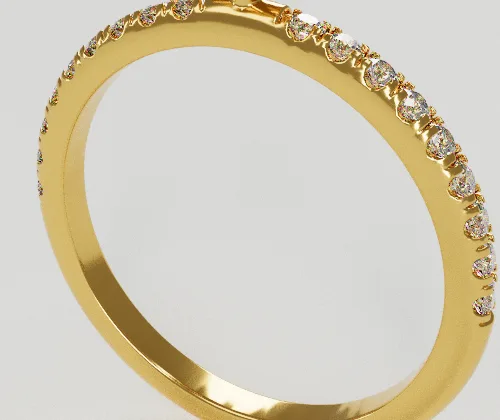
Polished
No texture: a smooth, mirror-bright surface.
Reflections stay sharp, so the piece mirrors the studio lights in crisp bands. Polished metal shows the shape of a design best, and every dent and seam with it.
Roughness 0.15 · Bridal, high jewellery, anything set with stones.
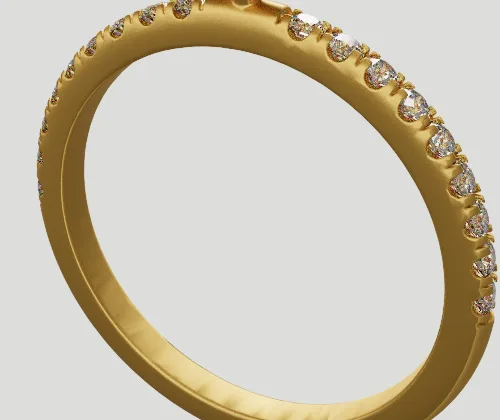
Brushed
Fine parallel grooves that follow the part: around a band, along a bar.
The surface is rougher across the grooves than along them, so a highlight stretches into a soft streak across the grooves, as on real brushed metal. Jart builds this as anisotropic roughness, not a printed pattern, so the grain turns with the form.
Roughness 0.38 · Men's bands, contrast panels next to a polished edge.
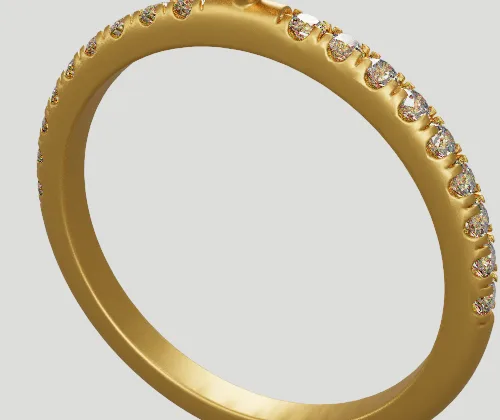
Satin
A very fine crossed texture, finer than brushing.
Reflections blur into an even, silky glow with no direction. Colour reads softer and the metal looks calm next to polished details.
Roughness 0.52 · Wedding bands, modern minimal pieces, inside a shank.
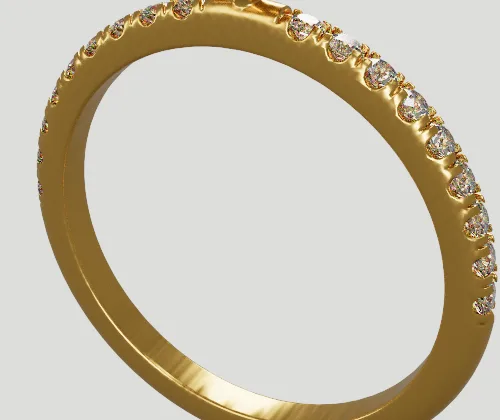
Hammered
Broad, irregular dimples, as left by a planishing hammer.
Each dimple catches its own highlight, so one reflection breaks into many small ones that move as the piece turns. Its relief is the strongest of the finishes.
Roughness 0.30 · Artisan bands, organic and handmade looks.
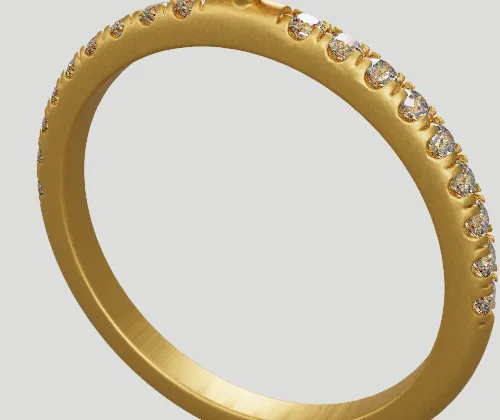
Sandblasted
A dense random grain, like a bead-blasted or frosted surface.
The most matte finish: highlights almost disappear and the colour of the metal reads evenly from every angle, like frosted glass for metal.
Roughness 0.55 · Frosted borders, contrast behind pavé, a soft-touch look.
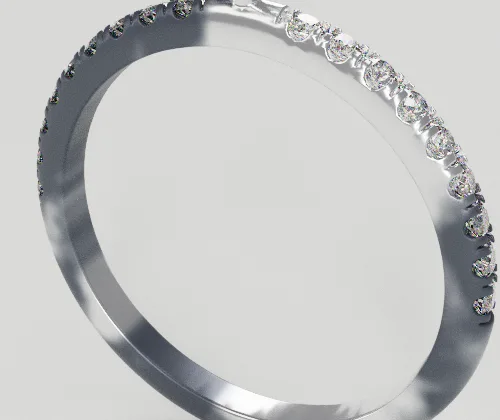
Patina
Mottled oxidised patches over the bare metal.
The patches are darker and duller than the metal between them, so light picks out the bare areas while the oxidised ones stay deep. Most effective on silver.
Roughness 0.42 · Oxidised silver, vintage and antique styles.
Using finishes in the studio
Open Materials → Surface finishes and choose a finish for the whole design's metal or for the part you selected. Every finish but polished has a Finish relief slider for the depth of the grain. Stones always stay polished.
For two-tone work, such as a satin band with a polished bezel, the two areas must be separate parts in the file: a design saved as one merged mesh takes one finish. Finishes show in Interactive, in Render and in the GLB export; check the grain around curved surfaces before you export. More in Metals, stones, finishes and looks.
The metals underneath
Gold, platinum and silver: the colour and density of every metal in the studio. The gemstone chart has the stones to set in them.
Render these finishes on your own design.
Open a 3DM, STL or GLB file, or a sample ring, choose the stone and the metal, and render it photoreal in your browser. No account needed.