Diamond
Diamond
Diamond is crystallised carbon and the hardest natural material. Its high refractive index bends light sharply, so a well-cut stone sends most of the light that enters its crown back out of the top, and its dispersion splits that light into the coloured flashes jewellers call fire.
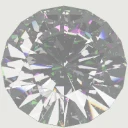 Diamond
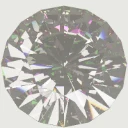 Diamond H
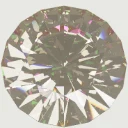 Diamond K
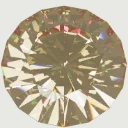 Diamond P
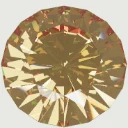 Diamond T
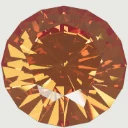 Yellow diamond
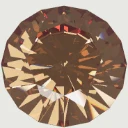 Champagne diamond
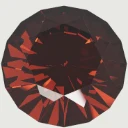 Cognac diamond
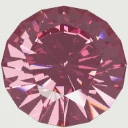 Pink diamond
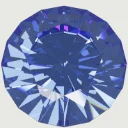 Blue diamond
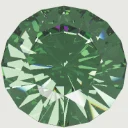 Green diamond
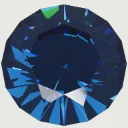
 Black diamond
At a glance
- Mineral
- Carbon, cubic crystal
- Refractive index
- 2.417
- Dispersion (C–F)
- 0.025
- Specific gravity
- 3.52
- Mohs hardness
- 10
- Wear
- Hard enough for any ring worn every day; a sharp knock on a thin girdle can still chip it.
Diamond in Jart
The 12 looks in the studio's material library, with the values the renderer uses.
| Stone | Colour | RI | Dispersion C–F | Abbe | SG | Colour depth |
|---|---|---|---|---|---|---|
| Diamond | #ffffff | 2.417 | 0.025 | 57 | 3.52 | 70 mm |
| Diamond H | #fff4dc | 2.417 | 0.025 | 57 | 3.52 | 45 mm |
| Diamond K | #ffeabd | 2.417 | 0.025 | 57 | 3.52 | 32 mm |
| Diamond P | #ffe199 | 2.417 | 0.025 | 57 | 3.52 | 24 mm |
| Diamond T | #ffd877 | 2.417 | 0.025 | 57 | 3.52 | 18 mm |
| Yellow diamond | #ffcc1f | 2.417 | 0.025 | 57 | 3.52 | 7.7 mm |
| Champagne diamond | #e2b98a | 2.417 | 0.025 | 57 | 3.52 | 12 mm |
| Cognac diamond | #c07b3d | 2.417 | 0.025 | 57 | 3.52 | 7 mm |
| Pink diamond | #f5a3c0 | 2.417 | 0.025 | 57 | 3.52 | 13.8 mm |
| Blue diamond | #8db7ff | 2.417 | 0.025 | 57 | 3.52 | 13.8 mm |
| Green diamond | #a5e0ad | 2.417 | 0.025 | 57 | 3.52 | 13.8 mm |
| Black diamond | #2a2a2e | 2.417 | 0.025 | 57 | 3.52 | 0.34 mm |
RI refractive index (nd). Dispersion C–F nF − nC, the spread between blue and red light; many gem tables quote the B–G figure instead (diamond 0.044, here 0.025). Abbe number: lower means more fire. SG specific gravity, used for carat estimates in Design Facts. Colour depth the path through the stone after which white light takes the stone's full colour; shorter paths look paler.
How it renders
With a refractive index of 2.417, a polished diamond facet reflects 17.2% of light that meets it face-on (diamond: 17.2%). Light inside the stone that meets a facet more than 24.4° from straight on cannot leave and is reflected back in; the smaller that angle, the more light a good cut returns to the eye (diamond 24.4°, quartz 40.4°).
Its dispersion (C–F) is 0.025, 100% of diamond's, which sets how much fire, the flashes of colour, a render shows under small, bright lights.
Every diamond preset shares the same optics; only the body colour and how fast it builds change. The colourless preset has no tint at all. The H, K, P and T grades take on a warm tint over a long path, so the tint shows more in a large centre stone than in pavé, the way it does in the case.
- 1 mm
- 3 mm
- 6 mm
- 10 mm
- 1 mm
- 3 mm
- 6 mm
- 10 mm
- 1 mm
- 3 mm
- 6 mm
- 10 mm
- 1 mm
- 3 mm
- 6 mm
- 10 mm
Related stones
Render diamond on your own design.
Open a 3DM, STL or GLB file, or a sample ring, choose the stone and the metal, and render it photoreal in your browser. No account needed.