Olivine
Peridot
Peridot is gem olivine, one of the few gems that comes in only one colour family: lime to olive green.
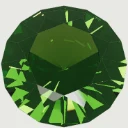 Peridot
At a glance
- Mineral
- Olivine (forsterite), green from iron
- Refractive index
- 1.67
- Dispersion (C–F)
- 0.012
- Specific gravity
- 3.34
- Mohs hardness
- 6.5–7
- Wear
- Moderately hard: good in earrings and pendants, rings with care.
Peridot in Jart
The look in the studio's material library, with the values the renderer uses.
| Stone | Colour | RI | Dispersion C–F | Abbe | SG | Colour depth |
|---|---|---|---|---|---|---|
| Peridot | #9bd23c | 1.67 | 0.012 | 56 | 3.34 | 6 mm |
RI refractive index (nd). Dispersion C–F nF − nC, the spread between blue and red light; many gem tables quote the B–G figure instead (diamond 0.044, here 0.025). Abbe number: lower means more fire. SG specific gravity, used for carat estimates in Design Facts. Colour depth the path through the stone after which white light takes the stone's full colour; shorter paths look paler.
How it renders
With a refractive index of 1.67, a polished peridot facet reflects 6.3% of light that meets it face-on (diamond: 17.2%). Light inside the stone that meets a facet more than 36.8° from straight on cannot leave and is reflected back in; the smaller that angle, the more light a good cut returns to the eye (diamond 24.4°, quartz 40.4°).
Its dispersion (C–F) is 0.012, 49% of diamond's, which sets how much fire, the flashes of colour, a render shows under small, bright lights.
It has more fire than sapphire, so a well-lit render shows small coloured flashes in its green.
- 1 mm
- 3 mm
- 6 mm
- 10 mm
Related stones
All gemstones · Metals · Stone and metal pairings · Finishes
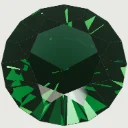
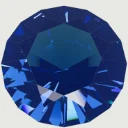
Render peridot on your own design.
Open a 3DM, STL or GLB file, or a sample ring, choose the stone and the metal, and render it photoreal in your browser. No account needed.